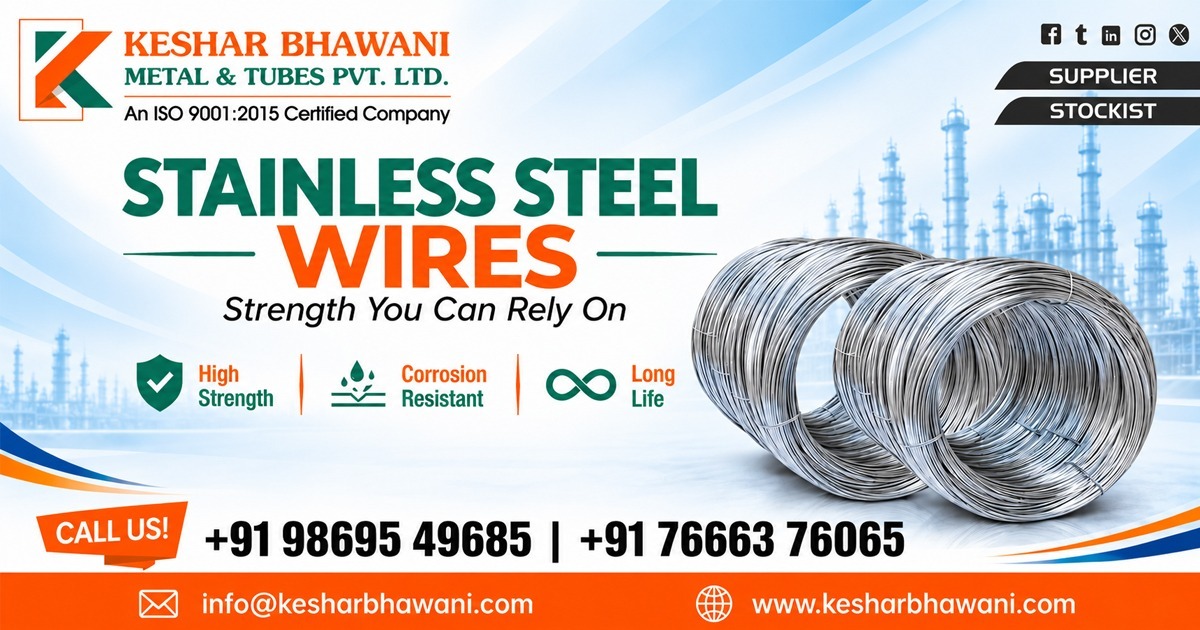
Stainless steel wire quality directly affects forming accuracy, product consistency, and manufacturing reliability. For industries sourcing Precision Stainless Steel Wires for Industrial Manufacturing in Mumbai, Maharashtra, Keshar Bhawani Metal & Tubes Pvt. Ltd. offers relevant material sourcing support.
How Wire Dimensions Influence the Final Manufactured Product
In industrial production, stainless steel wire is often used as an input material for components that require controlled dimensions, consistent handling, and suitable mechanical properties.
Even small variations in wire characteristics can affect downstream manufacturing operations.
Common production concerns include:
- Diameter variation: Inconsistent wire thickness can affect component dimensions and machine settings.
- Surface irregularities: Scratches or uneven finishes may create problems during drawing, forming, or finishing.
- Material inconsistency: Differences in material grade can influence corrosion resistance and mechanical performance.
- Processing difficulties: Incorrect wire selection may cause bending, forming, or feeding challenges.
Selecting suitable wire material before production helps manufacturers reduce avoidable process adjustments and maintain more consistent output.
Matching Stainless Steel Grades With Actual Operating Conditions
Stainless steel wire is available in different grades, and the correct selection depends on the environment in which the finished component will operate.
Two commonly considered options are:
SS 304 Stainless Steel Wire
- Suitable for many general industrial applications.
- Offers corrosion resistance in several everyday operating environments.
- Commonly considered for wire forms, fabrication components, and general manufacturing.
SS 316 Stainless Steel Wire
- Contains molybdenum, which improves resistance to certain corrosive environments.
- Considered for applications involving exposure to chlorides and more demanding conditions.
- Often evaluated for marine-related and chemical-processing environments.
Before placing an order, buyers should confirm the required grade, chemical composition, mechanical properties, and application-specific suitability.
The operating environment should guide material selection rather than choosing a grade only because it is commonly used in the industry.
What Happens During Stainless Steel Wire Manufacturing and Processing?
The manufacturing route can vary depending on the required diameter, material grade, surface condition, and final application.
A typical stainless steel wire production route may involve the following stages:
1. Raw Material Selection: Stainless steel material is selected according to the required grade and intended application.
2. Initial Processing: The material is prepared for wire production through suitable forming or rolling operations.
3. Wire Drawing: The material passes through drawing dies to achieve the required wire diameter.
4. Heat Treatment: Where required, controlled heat treatment helps achieve the intended mechanical properties.
5. Surface Finishing: Suitable finishing operations are performed according to the required surface condition.
6. Inspection and Packing: Diameter, surface condition, material identification, and packaging requirements are checked before dispatch.
The exact process depends on the product specification and manufacturing route. Buyers should discuss these requirements with their supplier before confirming an order.
Selecting Wire Diameter, Tensile Properties and Surface Finish
The purchasing specification should describe more than just the stainless steel grade. A wire that meets the grade requirement may still be unsuitable if its dimensions or mechanical properties do not match the production process.
Consider these points during selection:
- Wire diameter: Confirm the required nominal diameter and dimensional tolerance.
- Tensile strength: Match the mechanical properties with the intended forming or load-bearing requirement.
- Elongation: Consider how much deformation the wire must withstand during bending or forming.
- Surface finish: Specify the required finish according to the component’s appearance and functional requirements.
- Coil dimensions: Check coil weight, internal diameter, and external diameter for compatibility with handling and feeding equipment.
- Material grade: Verify whether SS 304, SS 316, or another specified grade is suitable.
- Processing condition: Clarify whether the wire will undergo bending, welding, drawing, twisting, or machining.
Providing a technical drawing or sample specification can help reduce misunderstandings between the buyer and supplier.
Where Precision Wire Materials Fit Into Industrial Production
Precision Stainless Steel Wires for Industrial Manufacturing are used in different production environments where material consistency, dimensional control, and suitable mechanical characteristics are required.
Typical application areas include:
- Automotive manufacturing: Wire components, formed parts, and selected fastening applications.
- Electrical equipment: Components and assemblies requiring stainless steel wire material.
- Engineering products: Fabricated wire parts and mechanical components.
- Industrial filtration: Wire-based mesh and filtration structures.
- Spring manufacturing: Applications requiring suitable strength and elasticity.
- Food processing equipment: Selected wire components used in equipment fabrication.
- Construction hardware: Fasteners, wire forms, and related industrial components.
- Chemical equipment: Components selected according to corrosion and operating conditions.
The final application determines the required material grade, diameter, finish, and mechanical properties.
Inspection Points That Should Be Confirmed Before Dispatch
Material inspection is an important part of stainless steel wire procurement. Buyers should establish acceptance requirements before the material reaches the production floor.
A practical incoming inspection checklist includes:
| Inspection Parameter | What to Verify |
| Material grade | Confirm the specified stainless steel grade |
| Diameter | Check actual wire diameter against the order |
| Dimensional tolerance | Verify acceptable dimensional variation |
| Surface condition | Look for scratches, cracks, rust, or visible defects |
| Mechanical properties | Review applicable tensile and elongation requirements |
| Material documentation | Check available material test certificates |
| Coil condition | Inspect winding, packaging, and handling condition |
| Identification | Match batch details with purchase documentation |
For critical manufacturing applications, buyers should also clarify the inspection method, sampling requirements, and acceptance criteria.
Preventing Wire Handling and Production Problems
Even correctly selected wire can create difficulties if it is stored or handled improperly.
Some common issues and their possible causes are listed below.
| Common Issue | Possible Cause | Practical Check |
| Wire feeding difficulties | Incorrect coil dimensions or winding | Verify coil compatibility with feeding equipment |
| Unexpected wire breakage | Unsuitable tensile properties or surface defects | Review material specifications and inspect samples |
| Inconsistent formed components | Diameter variation | Check incoming dimensional measurements |
| Surface scratches | Improper handling or storage | Inspect packaging and handling practices |
| Corrosion marks | Contamination or unsuitable storage conditions | Review storage environment and material handling |
| Excessive springback | Mechanical properties unsuitable for forming | Reassess material condition and forming requirements |
For storage, keep wire coils protected from moisture, chemical contamination, and unnecessary mechanical damage. Avoid placing coils directly on unsuitable surfaces.
If production problems continue, review the material specification and processing conditions with the relevant technical team rather than making unverified adjustments.
Industrial Material Sourcing Support From Keshar Bhawani Metal & Tubes Pvt. Ltd.
Industrial buyers often need more than a material quotation. They need clarity about grade requirements, dimensions, documentation, order quantities, and suitability for the intended manufacturing process.
Keshar Bhawani Metal & Tubes Pvt. Ltd. provides an industrial metal and tube sourcing reference for buyers evaluating stainless steel material requirements.
Through its website, kesharbhawani.com, buyers can explore the company’s business information and discuss their material requirements.
For projects involving stainless steel wire procurement, buyers should communicate:
- Required stainless steel grade and wire diameter.
- Dimensional tolerances and mechanical properties.
- Surface finish and intended manufacturing application.
- Required quantity, coil specifications, and delivery location.
- Documentation and inspection expectations.
The company information supplied for this article identifies manufacturing support from Ahmedabad, Gujarat, India. Buyers in Mumbai, Maharashtra, can discuss their project requirements and confirm the relevant material availability, specifications, and commercial terms directly.
Services
1. Material Requirement Consultation: Understanding the intended application, stainless steel grade, and dimensional requirements.
2. Product Selection Assistance: Evaluating suitable stainless steel material specifications for industrial manufacturing needs.
3. Order and Specification Coordination: Discussing quantities, dimensions, material documentation, and packaging expectations.
4. Industrial Procurement Support: Assisting buyers with requirement coordination and product-related communication.
Location
Mumbai’s engineering, fabrication, automotive, infrastructure, and manufacturing sectors create demand for stainless steel materials suitable for different industrial processes. Relevant commercial and industrial locations include Andheri, Goregaon, Malad, Kandivali, Borivali, Bhandup, Powai, Vikhroli, Ghatkopar, Chembur, Kurla, Sion, Lower Parel, Worli, Tardeo, Byculla, Fort, Navi Mumbai, Vashi, Turbhe, Mahape, Rabale, Airoli, Taloja, and Thane.
Frequently Asked Questions
Q: Which stainless steel grade is suitable for industrial wire manufacturing?
A: SS 304 is commonly considered for general industrial requirements, while SS 316 may be suitable for applications involving more demanding corrosive environments. The final choice depends on operating conditions and material specifications.
Q: Why does wire diameter tolerance matter in manufacturing?
A: Diameter variation can affect feeding, bending, forming, and the dimensions of finished components. Buyers should specify acceptable tolerances before ordering.
Q: What documents should buyers request when purchasing stainless steel wire?
A: Buyers can request available material test certificates, grade identification, dimensional inspection details, and applicable mechanical property information to verify the supplied material.
Q: How should stainless steel wire coils be stored before production?
A: Store coils in a clean, dry environment away from moisture and chemical contamination. Protect the wire from scratches, deformation, and improper handling.
Conclusion
Reliable wire procurement depends on matching stainless steel grade, diameter, mechanical properties, and surface condition with actual production requirements. Manufacturers in Mumbai can evaluate these factors before purchasing. Keshar Bhawani Metal & Tubes Pvt. Ltd. provides a point of contact for discussing industrial material requirements and sourcing support.
Discuss Your Stainless Steel Wire Requirements
Planning an industrial manufacturing project? Contact Keshar Bhawani Metal & Tubes Pvt. Ltd. to discuss stainless steel material requirements, product specifications, and procurement considerations.
Website: https://kesharbhawani.com/
Contact Number: +91 98695 49685 +91 93200 49685
Email Id: info@kesharbhawani.com
For more information and inquiries, feel free to contact us.
View Product: Click Here