Introduction
Industrial fabrication projects require flat steel sections with suitable dimensions, material properties, and surface conditions. Stainless Steel Flats for Fabrication and Structural Applications In Andhra Pradesh are used in equipment frames, supports, brackets, and fabricated assemblies where corrosion resistance and dimensional accuracy matter.
Understanding the Role of Stainless Steel Flats in Fabrication Work
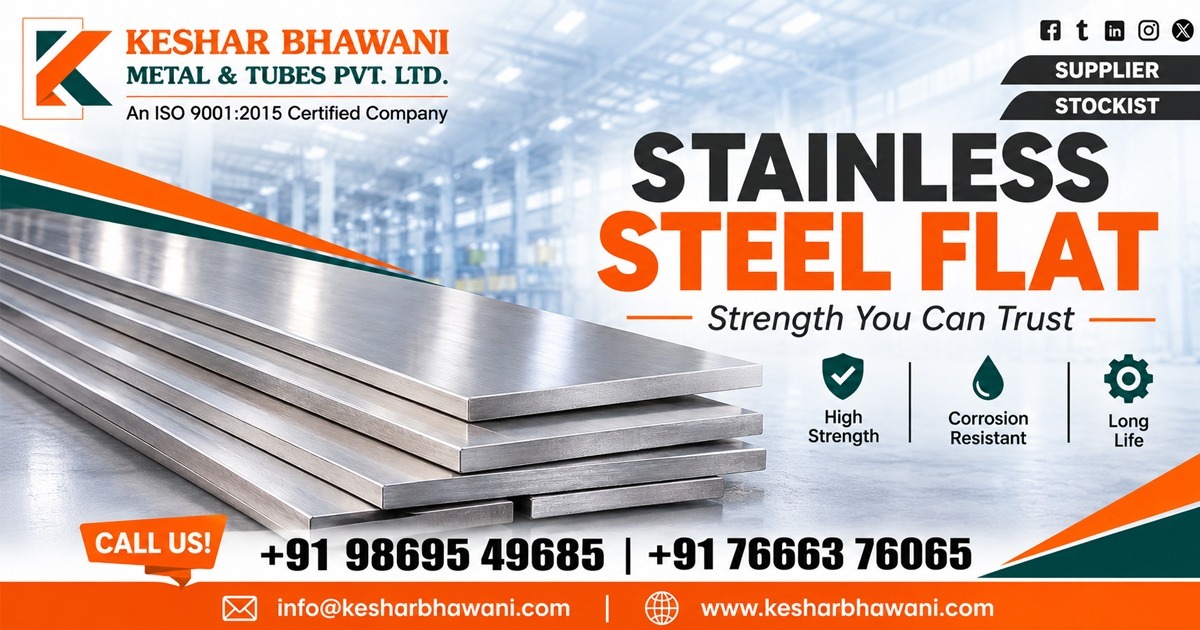
Stainless steel flats are solid, rectangular metal sections available in different widths, thicknesses, and lengths. Their straightforward shape makes them useful for manufacturing components that require a flat contact surface, straight edges, or a consistent cross-section.
Unlike stainless steel sheets, which are generally used for covering, cladding, and formed panels, flat bars are often selected for structural and supporting components.
Common fabrication requirements include:
- Equipment frames: Providing support for industrial machinery and assemblies.
- Mounting brackets: Creating connecting and fixing components for equipment.
- Structural supports: Fabricating frames, supports, and reinforcement sections.
- Machine components: Producing spacers, base supports, and machined parts.
- Industrial platforms: Supporting fabricated structures and selected framework components.
The rectangular profile also makes stainless steel flats convenient to cut, drill, weld, and machine according to the requirements of a fabrication drawing.
How Material Grade Influences the Final Fabricated Component
Selecting a flat bar based only on its dimensions can create problems during fabrication or installation. The stainless steel grade must also suit the operating environment.
Different grades offer different combinations of corrosion resistance, strength, weldability, and temperature suitability.
Some commonly specified grades include:
- SS 304: Commonly considered for general fabrication, equipment frames, and applications exposed to ordinary atmospheric or indoor conditions.
- SS 316: Often considered for environments involving greater exposure to chlorides or certain chemicals.
- SS 316L: A low-carbon grade frequently specified for welded components where the material’s corrosion performance after welding is important.
- SS 321: Used in selected applications where resistance to certain elevated-temperature conditions is required.
The correct choice depends on the actual chemical exposure, temperature, cleaning process, and fabrication method. A grade suitable for an indoor support frame may not be appropriate for a component installed near a coastal or chemical-processing environment.
For example, a hypothetical food-processing equipment project near Visakhapatnam may require a different material assessment from an indoor machinery frame installed in a dry industrial workshop.
Fabrication Processes That Determine Flat Bar Requirements
A stainless steel flat bar passes through several fabrication operations before becoming part of an industrial assembly. Buyers should consider these processes while preparing their material requirements.
1. Cutting and sizing
The material is cut according to the required component length. Accurate dimensions help reduce unnecessary machining and material wastage.
2. Drilling and machining
Holes, slots, and other features may be added for mounting or connecting components. The specified thickness and available machining allowance should be checked beforehand.
3. Welding and joining
Flat sections may be joined with other stainless steel components to produce frames, supports, or brackets. Grade compatibility, welding procedure, and surface preparation should be considered.
4. Finishing and inspection
After fabrication, components may require edge finishing, cleaning, or surface treatment. Sharp edges, heat marks, and contamination should be checked before installation.
One important industrial consideration is that stainless steel can lose some of its corrosion resistance locally when its surface becomes contaminated with carbon steel particles or unsuitable fabrication tools. Keeping stainless steel fabrication tools and work areas appropriately separated helps reduce this risk.
Where Stainless Steel Flat Sections Fit Across Industries
The application of flat bars depends on the component design and operating conditions. In Andhra Pradesh, industrial buyers may evaluate these materials for projects across several sectors.
Relevant applications include:
- Chemical processing: Equipment supports, brackets, and fabricated structural components.
- Food and beverage plants: Machine frames and selected equipment support structures.
- Pharmaceutical facilities: Fabricated supports and non-product-contact equipment components.
- Water treatment: Mounting arrangements, support structures, and selected fabricated assemblies.
- Engineering workshops: Machined parts, base plates, and general fabrication work.
- Marine-related projects: Components requiring grade selection based on saltwater exposure.
For load-bearing structures, stainless steel flat bars should be selected through engineering calculations rather than appearance or material grade alone. The section dimensions, unsupported length, loading direction, connection details, and support arrangement all influence structural performance.
Buyer Checks Before Ordering Stainless Steel Flats
A clear purchase specification helps avoid material mismatch, fabrication delays, and unnecessary processing costs. Buyers sourcing Stainless Steel Flats for Fabrication and Structural Applications In Andhra Pradesh should confirm the following details before requesting a quotation.
1. Material grade: Specify whether the application requires SS 304, SS 316, SS 316L, or another approved grade. Consider chemical exposure and environmental conditions.
2. Width and thickness: Provide exact dimensions based on fabrication drawings. These measurements influence component fit, machining requirements, and structural calculations.
3. Required length and quantity: Confirm standard or cut lengths, total quantity, and any cutting allowance needed for fabrication.
4. Manufacturing standard: Mention the applicable material specification, such as ASTM A276/A276M where appropriate for stainless steel bars and shapes. Confirm the applicable product form and purchase specification before ordering.
5. Surface finish and tolerances: Clarify whether hot-finished, bright, polished, or another finish is required. Check dimensional tolerances and straightness requirements, particularly for precision assemblies.
6. Material documentation: Ask for the material test certificate and traceability details when required by the project. Verify that the grade and heat identification correspond with the supplied material.
Connecting Fabrication Requirements with the Right Metal Supply Partner
Selecting a supplier involves more than checking the quoted price. Buyers should evaluate whether the supplier understands the material category, can clarify product specifications, and can coordinate the required supply details.
Keshar Bhawani Metal & Tubes Pvt. Ltd. lists Angle, Channel & Flats under its industrial raw materials portfolio, alongside stainless steel sheets, plates, coils, pipes, tubes, bars, wires, and rods. The company identifies itself as a stockist and supplier of industrial metal materials.
Its website also identifies industrial sectors such as chemical plants, oil and refineries, food and beverages, sugar and paper mills, heavy machinery, and water treatment facilities.
For buyers exploring Stainless Steel Flats for Fabrication and Structural Applications In Andhra Pradesh, the company can be approached to discuss:
- Required stainless steel grade and dimensions.
- Flat bar availability and applicable product specifications.
- Quantity and length requirements.
- Material documentation and inspection expectations.
- Project-specific supply coordination.
The manufacturing support location specified for this requirement is Mumbai, Maharashtra, India. The company’s website lists its registered office in Mumbai; buyers should confirm the exact manufacturing, stocking, and dispatch arrangement when discussing an order.
Website: Keshar Bhawani Metal & Tubes Pvt. Ltd.
Supporting Fabrication and Infrastructure Projects Across Andhra Pradesh
Andhra Pradesh has industrial and infrastructure activities involving engineering, food processing, pharmaceuticals, chemicals, marine-related operations, and manufacturing. These sectors create demand for metal sections used in equipment fabrication, structural supports, and industrial assemblies.
Buyers looking for Stainless Steel Flats for Fabrication and Structural Applications In Andhra Pradesh may have sourcing requirements across the following locations:
Visakhapatnam, Vijayawada, Guntur, Tirupati, Kurnool, Nellore, Kakinada, Rajahmundry, Anantapur, Kadapa, Eluru, Ongole, Srikakulam, Vizianagaram, Machilipatnam, Amaravati, Tenali, Proddatur, Hindupur, Chittoor, Tadepalligudem, Bhimavaram.
These locations represent potential industrial and commercial sourcing markets, not individual company branches or service centres. Buyers can coordinate their requirements with the Mumbai-based support location and confirm applicable supply and transportation arrangements.
Frequently Asked Questions
1. Which stainless steel grade is suitable for industrial fabrication flats?
SS 304 is commonly considered for general fabrication, while SS 316 and 316L may be more appropriate for certain corrosive environments. Final selection depends on actual operating conditions.
2. What dimensions should buyers provide when ordering stainless steel flats?
Specify width, thickness, length, quantity, dimensional tolerance, and required surface finish. Providing a fabrication drawing can further reduce specification misunderstandings.
3. Can stainless steel flats be welded and machined?
Yes. Stainless steel flats can generally be cut, drilled, machined, and welded using suitable processes. The material grade and fabrication procedure should be considered before processing.
4. What should Andhra Pradesh buyers check before selecting a supplier?
Confirm material grade, dimensions, applicable standards, availability, documentation, pricing, and dispatch arrangements. These details help ensure that the supplied material matches project requirements.
Conclusion
Choosing the right stainless steel flat requires attention to grade, dimensions, fabrication methods, and the environment in which the finished component will operate. For industrial buyers in Andhra Pradesh, clear specifications can simplify procurement and reduce fabrication-related issues. Contact Keshar Bhawani Metal & Tubes Pvt. Ltd. to discuss your material requirements and supply details.
Contact Number: +91 98695 49685 +91 93200 49685
Email Id: info@kesharbhawani.com